
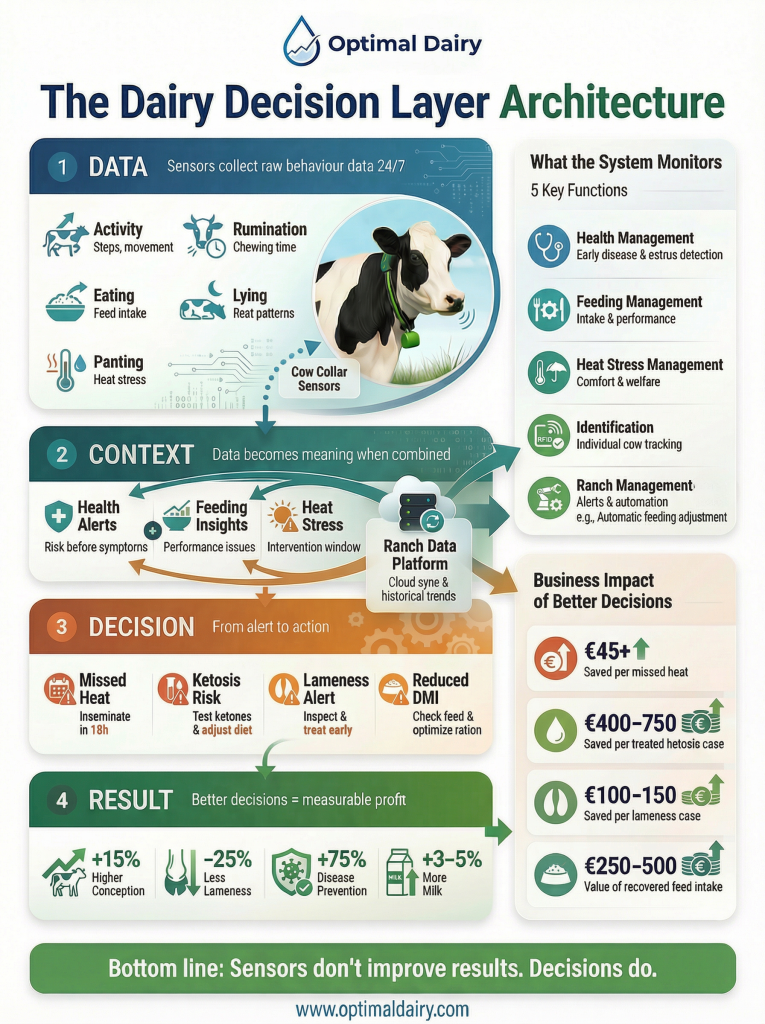
Why Dairy Farms Miss Heats and How Activity Monitoring Improves Reproductive Management. Many dairy farms lose thousands of euros every year for one simple reason: missed heats. Reproduction problems in dairy herds rarely start with semen quality or veterinary intervention. Much earlier in the process, something simpler happens. The heat is simply missed. If estrus is not detected, insemination never happens. If insemination does not happen, the cow returns to the next reproductive cycle. And this is exactly where many dairy farms lose time, fertility, and money. In modern dairy farming, reproduction is not only a biological process. It is also a decision process. And many reproductive problems start with a simple issue: estrus detection failure.
Why Dairy Farms Miss Heats
On many farms, heat detection still relies primarily on visual observation. Farmers look for behavioral signs such as: mounting activity, restlessness, increased movement, mucus discharge, standing heat. The problem is not that these signs do not exist. The real problem is timing. Estrus in dairy cows typically lasts only 8–18 hours, and the most intense activity often occurs during the night.If cows are observed only during routine barn work, many estrus events pass unnoticed.
How Many Heats Are Missed on Dairy Farms?
Studies from commercial dairy farms show a consistent pattern. When heat detection relies only on visual observation, farms typically detect around: 50–60% of estrus events. This means that 40–50% of heats may be missed.Each missed estrus event leads to: delayed insemination, longer calving intervals, more days open. Ultimately, this reduces the overall reproductive efficiency of the herd. The Economic Cost of Missed Estrus. Time is one of the most expensive factors in dairy reproduction.Every additional day open has a measurable economic impact. Depending on the production system, estimates range between: 3–5 € per cow per day. If a missed heat delays insemination by one cycle (about 21 days), the cost per cow can reach: 63–105 €. In a herd of 100 cows, this can easily translate into several thousand euros per year. The most important point is that these losses are often invisible in financial reports. They remain hidden costs of missed reproductive decisions.
Estrus Is Not Ovulation
Even when estrus is detected, insemination often happens at the wrong time. A key biological fact is frequently overlooked: Estrus is not ovulation.Ovulation typically occurs about: 24–32 hours after the beginning of estrus. The optimal insemination window is therefore: 12–18 hours after the onset of standing heat. If insemination happens too early or too late, conception rates decline. In many cases the issue is not semen quality. The real problem is decision timing. Signs of Heat in Dairy Cows. Even with modern technology, understanding the biological signs of estrus remains important. Typical symptoms include: standing to be mounted by other cows, increased walking and restlessness, vocalization, reduced feed intake, mucus discharge, swollen vulva. However, in high-producing dairy cows, these signs are often less visible or shorter in duration. This is one reason why visual heat detection alone has become less reliable in modern dairy systems.
Why Modern Dairy Farms Are Changing Their Approach
Many dairy farms are now shifting from observation-based heat detection to data-driven reproductive management. Estrus changes cow behavior in several measurable ways, including: increased activity, reduced rumination, changes in feeding patterns, more frequent standing and walking. These behavioral changes are very clear when monitored continuously. However, a human observer cannot monitor cows 24 hours per day. Technology can. Activity Monitoring Systems in Dairy Farming. This is why many modern farms now use activity monitoring systems. One example is MooCollar Bree, developed by Sveaverken Global. The collar continuously monitors cow behavior, including: activity levels, rumination, feeding behavior. By analyzing these parameters, the system can detect estrus events and identify early health changes in the herd. For farmers, this means: fewer missed heats, more accurate insemination timing, faster response to health issues.
Herd Data Available Anywhere
The system works together with the MooConnect cloud platform, where herd data can be accessed from a computer or mobile device. Farmers can monitor: estrus cycles, breeding events, pregnancy checks, health alerts, treatment history. Having this information in one place allows reproductive management to become far more precise. Decisions are based on continuous herd data, not only occasional observation. The Biggest Change in Modern Reproductive Management. The biggest transformation in dairy reproduction is not the technology itself. It is the decision process. In traditional systems: farmers search for estrus. In data-driven systems: the system notifies the farmer when estrus occurs. That difference may seem small, but it fundamentally changes herd management. Because in dairy farming, the most expensive mistakes are often the ones that go completely unnoticed. As many dairy consultants say: Most dairy farms don’t lack data. They lack decisions.
Best Time to Inseminate a Dairy Cow
Successful breeding depends heavily on timing. The generally recommended moment for insemination is: 12–18 hours after the onset of standing heat. This timing ensures that viable sperm cells are already present in the reproductive tract when ovulation occurs. Accurate estrus detection therefore becomes one of the most important factors determining conception success. Activity monitoring systems help farmers identify the beginning of estrus much more precisely than visual observation alone.
Studies show that reproductive efficiency depends largely on estrus detection and conception rate.
FAQ. Estrus Detection in Dairy Cows
Missed heat
↓
21 days delay
↓
Longer calving interval
↓
Lower lifetime milk
↓
Lost profit
Estrus Cycle in Dairy Cows
Brief explanation:
- 21-day cycle
- estrus 8–18 hours
- ovulation 24–32 hours
How long does estrus last in dairy cows? Estrus typically lasts between 8 and 18 hours, although behavioral changes may begin earlier. Why do farmers miss heats? Heats are often missed because estrus signs can be short and subtle, and many occur during the night when cows are not observed. What is silent heat in dairy cows? Silent heat occurs when ovulation takes place but visible behavioral signs are weak or absent. This is common in high-producing dairy cows. How accurate are activity monitoring systems? Modern activity monitoring systems can detect estrus with 90–98% accuracy, depending on herd management and system configuration. Why is correct insemination timing important? Insemination must occur before ovulation. The optimal timing is usually 12–18 hours after the onset of standing heat, ensuring the highest probability of conception.
Educational Note
This article is published as part of the educational content of Optimal Dairy™. Its purpose is to help dairy farmers better understand reproductive management and the role of Precision Livestock Farming (PLF) technologies in modern dairy herd management. The content focuses on practical knowledge that supports better decision-making in dairy production systems. In modern dairy farming, reproduction is not only about biology.
It is about decision quality.